
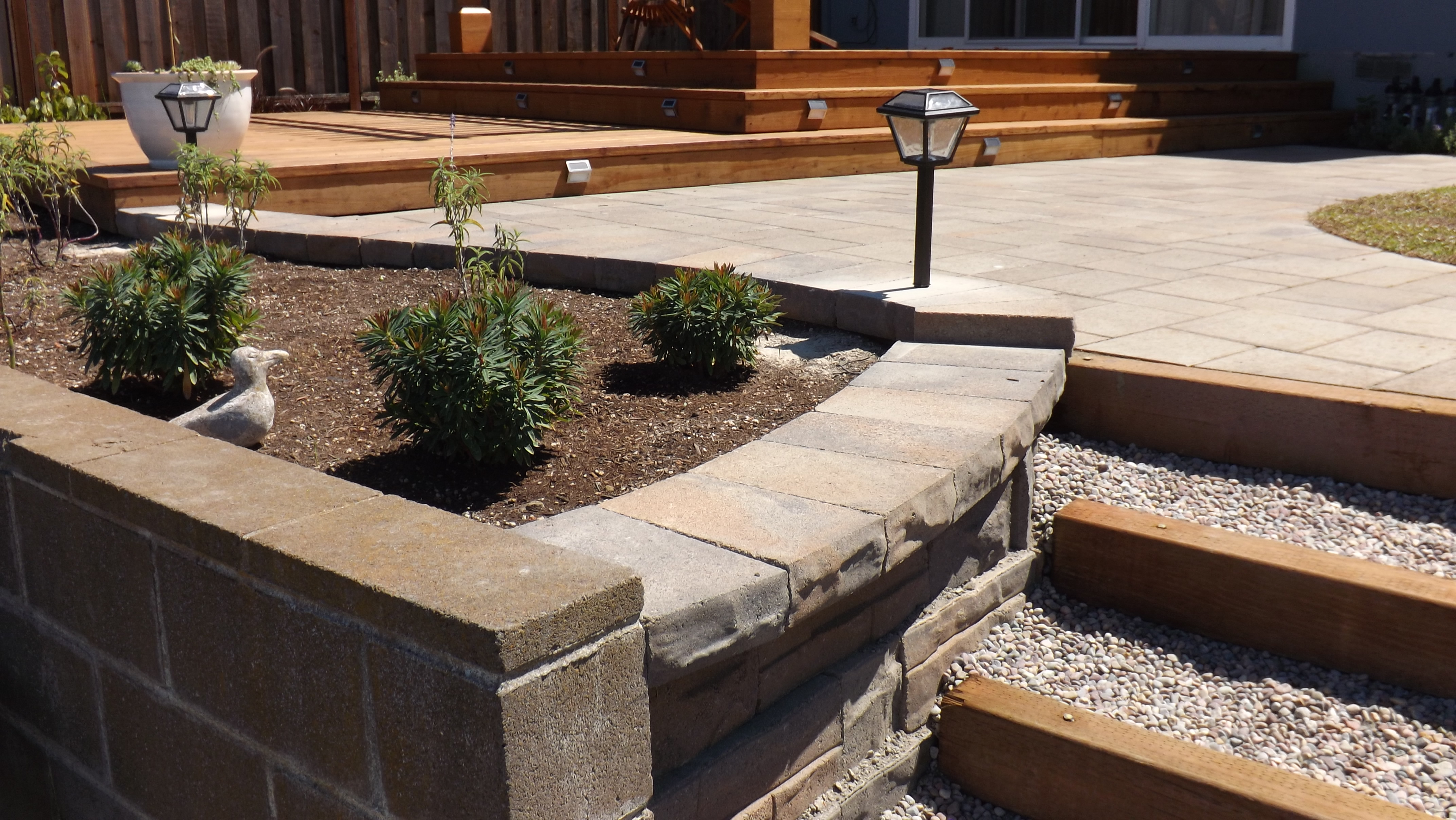
Retaining walls do quiet, essential work — they hold back a slope so the ground above doesn't end up in the yard below. In the hills of Oakland, Berkeley, and El Cerrito, they're often what makes a steep, unusable lot into a flat, usable space. But before you build one, there's an important question: do you need a permit? Here's how it works in Oakland and across the East Bay, in plain English.
The 4-foot rule
The general standard across California — and in Oakland — comes down to height. A building permit is NOT required for a retaining wall that is 4 feet or less in height, measured from the bottom of the footing to the top of the wall — as long as it isn't supporting extra load. Two things surprise people: you measure from the bottom of the footing (not the ground), so a wall that looks 3½ feet tall may actually be over 4 feet once you include the buried footing; and anything taller than 4 feet needs a permit and, in most cases, structural engineering.
The surcharge exception (the big one)
Height isn't the only trigger. A retaining wall of ANY height needs a permit if it supports a surcharge — extra load pressing on it from above. That includes a driveway, patio, or parking area above the wall; a slope or hillside bearing down on it; or a structure, deck, or another wall above it. On East Bay hillside lots this is extremely common — a wall only 3 feet tall but holding up a sloped backyard usually still needs a permit and engineering.
Oakland's specific rules
If your project is in Oakland: a building permit is required to build, repair, or replace a retaining wall (except walls under 4 feet not supporting a surcharge); walls generally cannot exceed 8 feet in height; multiple walls must be separated by at least 4 feet between their exposed faces (which is why you see tiered, terraced walls on steep lots); if the wall is visible from the street or a neighboring lot it may require Design Review and an approved finish material; and structural calculations are required for permitted walls. Other East Bay cities follow the same 4-foot and surcharge principles but each has its own process — always confirm with your city's building department.
Why this matters more than it seems
An unpermitted retaining wall isn't just a paperwork problem. It can fail — walls holding back real slope loads need to be engineered correctly, or they bulge, lean, and eventually collapse. It can complicate a home sale, since unpermitted structural work is a red flag in inspections. And it costs more to fix later than to do right the first time.
The easy part: let your contractor handle it
When you hire a licensed contractor, permits and engineering aren't your headache. A properly licensed contractor knows when a permit is required, works with engineers when the wall calls for it, pulls the paperwork, and builds to code with the drainage that keeps the wall standing through our wet winters. Reppard's Landscaping is a licensed California contractor (License #1022906) with more than 30 years building retaining walls and terracing steep lots across the East Bay. We'll tell you straight whether your project needs a permit — and handle it if it does. Call or text (510) 391-3679 for a free estimate.
This article is general information, not legal or engineering advice. Permit requirements vary by city and by project. Always confirm with your local building department — in Oakland, Planning & Building can be reached at (510) 238-3891.